Thank you, Madam Vice- President,
Distinguished delegates,
Ladies and Gentlemen,
Your Excellencies,
The people of the Democratic Republic of the Congo are trapped in a dense web of crises: the proliferation of armed groups, foreign interference, ethnic tensions, and fragile governance, amid a fierce competition over natural resources.
Since the High Commissioner’s last update in September, our monitoring reveals a deteriorating human rights and security situation in the east. Civilians are under attack by numerous armed groups, notably the Rwandan-backed M23, the Allied Democratic Forces or the ADF, and CODECO. They also bear the brunt of clashes between these groups and the Congolese armed forces, supported by allied Wazalendo militias.
From October 2025 to February 2026, our Office documented 2,560 human rights violations affecting 6,760 victims – the vast majority in the provinces of North Kivu, South Kivu, Ituri, and Maniema. The real toll is likely to be significantly higher.
The ADF has expanded its operations across Ituri, North Kivu, and Tshopo since October, killing more than 260 people, displacing many thousands, and subjecting women and girls to sexual slavery, resulting in dozens of pregnancies.
December saw a sharp escalation in South Kivu, where fighting intensified between the Alliance Fleuve Congo, or AFC, and M23, supported by Rwanda, on one side and the Congolese army and Wazalendo groups on the other. All parties committed violations of international human rights and humanitarian law, including the indiscriminate use of heavy weapons that claimed many civilian lives.
The city of Uvira changed hands twice during this reporting period. Atrocities by armed groups against civilians persisted regardless of who held control and that included summary executions, death threats, extortion, and looting. Religious sites and leaders, as well as humanitarian and civil society organizations, were attacked, in blatant violation of international law.
Our own team discovered several mass graves in the area after the withdrawal of the M23. Testimony from local people indicates that as many as 200 victims may have been buried.
This violence triggered mass displacement within the DRC and across its borders.
We are also concerned about the increased use of drones, artillery, and other explosive weapons by all parties, including in densely populated areas, causing severe harm to civilians and essential infrastructure.
In February, the conflict monitoring organization ACLED recorded 31 drone and airstrikes in the DRC – the highest monthly figure on record. Tragically, two weeks ago, a drone strike in Goma killed our UNICEF colleague, Karine Buisset, along with at least two others. The authorities have launched an investigation into the attack.
Repeated drone attacks targeting Bangoka Airport in Kisangani, Tshopo province, have sown widespread panic and forced residents to flee, signalling a worrying spillover of hostilities well beyond the established conflict zones.
Madam Vice-President,
In the past five months alone, our Office documented some 600 summary executions, claiming more than 1,300 lives. Nearly 1,500 people were abducted during the same period; a further 1,200 were subjected to physical violence, including torture, rape, and other inhumane treatment.
The persistent use of sexual violence as a weapon of war inflicts unspeakable suffering on Congolese women and girls. Since October, our Office has identified some 450 victims of sexual and gender-based violence, while UNICEF continues to sound the alarm on escalating sexual violence against children.
Many of these wounds do not heal, leaving communities in chronic pain that lasts for generations.
Our staff in the DRC provide victims with legal assistance and refer them to support services. On 9 March, we launched a nationwide campaign to mobilize action against sexual slavery, and protect the rights of victims and children born of rape.
It is particularly worrying that while armed groups remain the primary perpetrators of abuses – especially the M23, Wazalendo, and ADF – State forces are responsible for more than one-quarter of documented human rights violations, and over one-third of cases of sexual violence.
Ensuring accountability for all violations and abuses is essential to curbing this violence.
Yet national capacity to collect and preserve evidence remains woefully inadequate and uneven. The DRC has only three forensic doctors for a population of over 100 million.
Since September, our Office has supported the Ministry of Higher Education with new forensic training programmes, and facilitated three joint judicial investigation missions and five mobile court hearings.
Madam Vice-President,
Hate speech and dehumanizing rhetoric are pouring fuel on already blazing tensions.
In North and South Kivu, there has been a surge in hate speech targeting Congolese Tutsis, who are accused of supporting the Rwandan-backed M23. We documented xenophobic rhetoric particularly directed at Tutsi women.
We are also deeply concerned about escalating tensions in western DRC, where intercommunal violence between Teke and Yaka communities caused massive destruction, displacing at least 146,000 people. Despite reconciliation efforts led by the authorities, hostilities continue to intensify.
The DRC’s vast natural wealth feeds the economy of war.
Competition for minerals, illegal mining, smuggling, and weak oversight not only drive instability – they spread disease, they contaminate land, and they uproot communities.
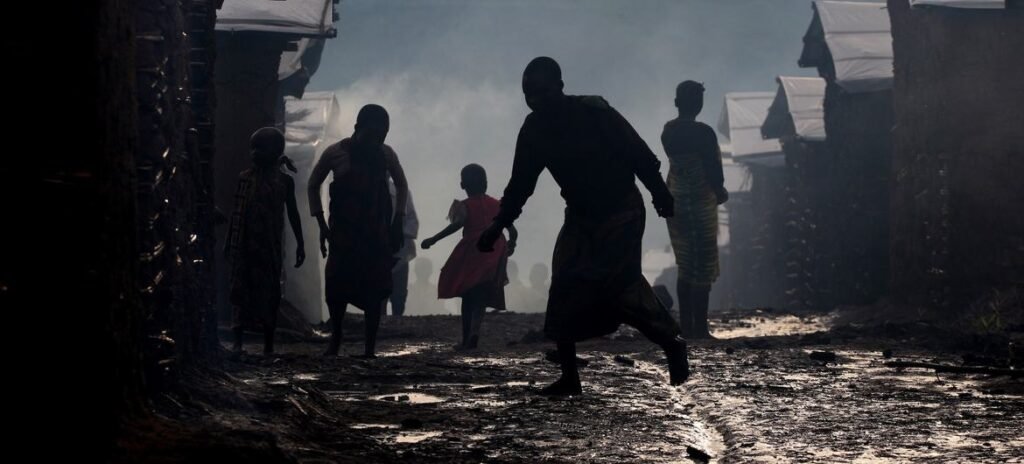
The DRC is one of the world’s gravest humanitarian crises. Across the country, more than 26 million people are facing acute hunger, nearly half of all children under five are stunted due to chronic malnutrition, and over eight million people have been displaced.
Amid hardship and uncertainty, a strong civil society could provide relief and advance accountability.
And yet civic space in the DRC is steadily shrinking.
Journalists, human rights defenders, and members of the political opposition face intimidation, harassment, and arbitrary detention.
Between last October and February, 42 opposition members have been arrested for expressing their views. The whereabouts of some are unknown, possibly amounting to enforced disappearance.
Since October, the National Cyber Defence Council has arbitrarily detained 82 people, primarily political opponents, media professionals, and human rights defenders. Many are held incommunicado in unofficial locations, including private residences, and are denied access to legal counsel. We also verified cases of torture and other ill-treatment.
Congolese civil society has called for the dissolution of this body, and we urge the Government to heed these calls.
Since October, our Office has supported 150 journalists, human rights defenders, and their family members, who faced threats and harassment from State officials and armed groups.
Madam Vice-President,
We welcome constructive steps taken towards a ceasefire and peace last year in Doha and in Washington. However, the reality on the ground is lagging behind.
A change of course is urgently needed. As negotiations continue, people clearly cannot wait.
We call on all parties to the conflict to immediately cease hostilities, protect civilians, and respect international law in full.
The international community – particularly those with influence – must apply maximum diplomatic pressure to ensure that commitments are translated into reality.
Rwanda must withdraw its forces from the DRC and respect its territorial integrity. It must also cease its support to the M23.
We urge the DRC authorities to end repression of the political opposition, journalists, and human rights defenders, release all those arbitrarily detained, and ensure they can exercise their rights freely, in line with the country’s international human rights commitments.
Lasting peace is impossible without human rights. We call on all parties involved in the peace processes to prioritize the voices and the rights of affected people – particularly the need for truth, justice, and reparation. Our Office remains ready to support these efforts, including by proposing confidence-building measures which can help protect civilians and rebuild trust.
However, to fulfil its mandate, our Office itself needs adequate financial support.
As you all know, severe funding cuts have already affected our work in the DRC.
Despite this Council’s call for the deployment of eight forensic experts to our DRC Office, none have been deployed due to financial constraints. And this limits our ability to investigate grave abuses.
Last year, the Commission of Inquiry established by this Council received no funding to operationalize its mandate, and this year resources remain significantly reduced. We are making every effort to support the Commission, but regrettably its operations remain limited.
Madam Vice-President,
We need bold, collective action to cut the Gordian knot of crises that has suffocated the Congolese people for far too long.
With its young and diverse population, the DRC holds the promise of a better future – but only if its people can harness their capabilities and their aspirations to build that future in dignity and in peace.
Thank you, Madam Vice-President.
© 2025 INTERNATIONAL HUMAN RIGHTS MONTHLY. ALL RIGHTS RESERVED | Privacy Policy
Adding {{itemName}} to cart
Added {{itemName}} to cart